How Cappadocia Balloons Inflate and Land: The Full Procedure
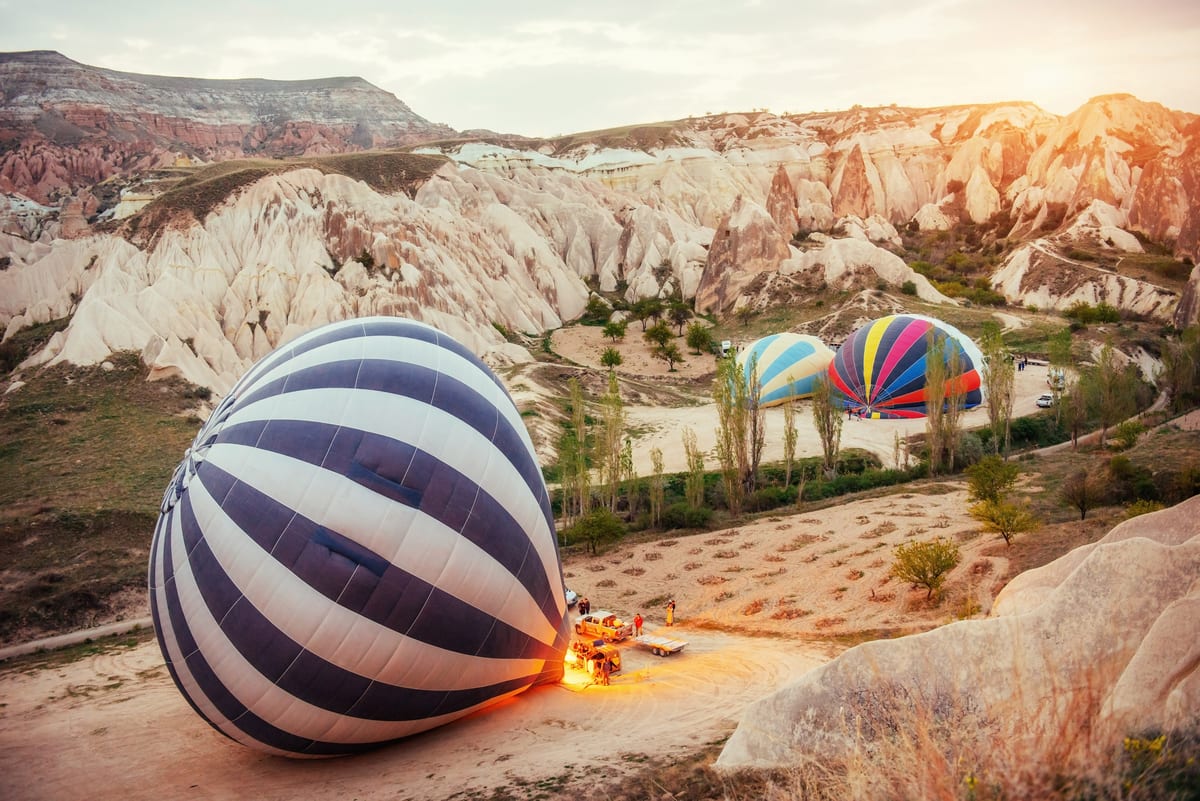
The envelope lies flat across the field, ripstop nylon spread out in the dark. Two crew members hold the mouth open. A large fan begins to push cold air inside. Before long, this fabric becomes a tall standing structure, ready to carry passengers over the fairy chimneys. The transformation from flat fabric to flight is one of the most fascinating parts of the balloon experience—and many passengers arrive just in time to miss it.
What Happens Before You Arrive?
The ground crew reaches the launch site well before passenger arrival. They unload the basket from the trailer, connect the burner frame, and attach the envelope to the basket via steel carabiners and load tapes (the strong webbing that distributes weight across the envelope). The propane tanks are connected and pressure-tested. The pilot checks each burner for ignition and flame quality.
While the crew prepares, SHGM’s meteorological team is assessing wind, visibility, and precipitation. There is no fixed daily announcement time—the fly/no-fly decision can be confirmed the evening before, in the early hours before pickup, or at the last minute, depending on conditions. Only after SHGM gives the green light does the inflation sequence begin.
Stage 1: Cold Inflation
Cold inflation is the first stage. A powerful gasoline-powered fan is positioned at the mouth of the envelope, blowing ambient air into the fabric. Two crew members hold the mouth open while the fan pushes air inside at high volume. The envelope slowly fills, changing from a flat sheet on the ground into a horizontal tube shape.
This stage takes about 5–8 minutes. During cold inflation, the pilot walks around the envelope checking for:
- Fabric integrity—no tears, no worn panels, no loose seams
- Load tape alignment—the webbing should run straight from crown to basket
- Parachute valve position—the top vent (used for controlled descent) must be properly sealed
- No debris inside the envelope—rocks, insects, or moisture can cause problems
If you arrive early enough, this is a spectacular sight. Dozens of colored envelopes spread across the field, slowly inflating in the pre-dawn darkness, illuminated by vehicle headlights and the occasional burst of flame from a nearby balloon already in hot inflation.
Stage 2: Hot Inflation
Once the envelope is filled with cold air and has taken its full horizontal shape, the pilot fires the burner into the mouth of the envelope. This is the moment the balloon comes alive. The air inside heats rapidly—propane burners produce flames that can reach very high temperatures at the tip, heating the air inside the envelope to approximately 100°C above ambient temperature.
As the air heats, the envelope becomes buoyant. It begins to rise from horizontal to vertical. The basket, lying on its side during cold inflation, tilts upright as the envelope pulls it. Crew members hold ropes attached to the basket and crown to control the rate of rise. The pilot manages the burner in short, controlled blasts.
Hot inflation takes about 3–5 minutes. By the end, the balloon is standing fully upright, the basket is stable on the ground, and the envelope towers above—roughly 20–30 meters tall depending on the balloon size.
Stage 3: Passenger Boarding
With the balloon upright and the basket stable, passengers board. The basket has footholds cut into the wicker sides—you step up and swing your leg over the wall, which is about 1.1–1.3 meters high. Crew members assist on both sides. Larger baskets often have internal partition walls that divide passengers into groups of 4–5 per compartment.
The pilot assigns compartments based on weight distribution. This is not random—pilots typically calculate total passenger weight in advance and plan the loading pattern accordingly. During boarding, the ground crew holds ropes to keep the basket from lifting prematurely.
Once everyone is aboard, the pilot typically delivers a short safety briefing (often around 2–3 minutes) covering how to hold on during landing, the brace position (knees bent, facing direction of travel, hands on rope handles), and where the fire extinguisher is located. For a full breakdown of the in-basket experience, see our guide to what happens inside the basket.
Stage 4: Launch
Launch is surprisingly gentle. The pilot fires a sustained burner blast, the envelope gains buoyancy, and the basket lifts off the ground. There is no jolt, no sudden acceleration. The ground simply drops away, often so smoothly that the exact moment of liftoff is easy to miss—many passengers only realize they are airborne when they look down and see the crew waving from below.
The initial climb rate is typically 1–3 meters per second. The pilot controls altitude by managing burner output: more heat equals more lift, less heat allows gradual descent. The parachute valve at the top of the envelope can release hot air for faster descent when needed.
Within the first few minutes, the pilot navigates the balloon away from the launch field and toward the valleys. On a busy morning, many balloons launch from a relatively small area in a short window. Pilots coordinate via radio, using different altitude layers to maintain separation from other balloons in the air.
How Does the Pilot Control Direction?
Hot air balloons have no steering mechanism. The pilot controls altitude only—up and down. Direction comes from the wind. Wind can blow in different directions at different altitudes, and Cappadocia’s volcanic terrain often creates layered wind patterns each morning. An experienced pilot reads these layers on the day and adjusts altitude accordingly—for example, the wind at one altitude band might drift toward Love Valley while a different altitude band drifts toward Pigeon or Rose Valley, though the exact altitudes and directions change from morning to morning and cannot be predicted in advance.
By climbing and descending through these layers, the pilot effectively “steers” the balloon across the landscape. This is why balloon flight is often called the art of controlled drifting. Licensed pilots read these wind layers fresh each morning and adjust altitude accordingly, though the exact path still depends on how the wind is behaving that day.
Stage 5: Approach and Landing
About 10–15 minutes before landing, the pilot radios the chase crew with a projected landing zone. The chase vehicle—a truck carrying a flatbed trailer—drives to the area and positions itself. The pilot begins a gradual descent, using the parachute valve and reduced burner input to lower the balloon.
The ideal landing involves the basket touching down directly on the trailer. This requires precise coordination between the pilot, the wind, and the chase crew. The crew uses long ropes called “crown lines” attached to the top of the envelope to guide the balloon during the final meters.
What does landing feel like?
In calm conditions, landing is barely noticeable. The basket settles onto the trailer with a soft bump, and the crew secures it. In windier conditions, the basket may drag along the ground for a few meters before stopping—this is normal and the wicker construction is designed to absorb the impact. The pilot instructs passengers to assume the landing position: knees bent, facing the direction of travel, hands gripping the rope handles.
After the basket is stable, passengers climb out one compartment at a time. The ground crew assists on the other side. The champagne celebration follows immediately—your pilot pops the bottle, pours glasses, and presents flight certificates right there in the landing field.
Stage 6: Deflation and Pack-Up
While you sip champagne, the crew begins deflating the envelope. The parachute valve is opened fully, releasing hot air from the top. Crew members squeeze air out of the fabric and fold the envelope into a long, narrow bundle. The entire pack-up takes about 15–20 minutes. The envelope, basket, and burner frame go back on the trailer and return to the hangar for inspection and storage.
Timeline Summary
These are typical, approximate ranges—actual timing varies by operator, weather, and group size.
| Stage | Duration | What Happens |
|---|---|---|
| Crew setup | 15–20 min | Basket unloaded, burner connected, fuel checked |
| Cold inflation | 5–8 min | Fan fills envelope with ambient air |
| Hot inflation | 3–5 min | Burner heats air, envelope stands upright |
| Boarding + briefing | 5–7 min | Passengers enter basket, safety briefing |
| Flight | ~60 min | Sunrise flight over valleys and fairy chimneys |
| Landing | 2–5 min | Descent, trailer landing, crew secures basket |
| Celebration | 10–15 min | Champagne toast and flight certificates |
For a complete morning timeline from hotel pick-up to drop-off, see our flight duration guide. To know what to bring and wear, check our what to wear guide.
Why Understanding the Procedure Matters
Knowing what to expect removes anxiety. If you understand why the basket tilts during hot inflation, you will not worry when it happens. If you know the landing position, you will feel confident when the pilot calls for it. The procedure has been refined over more than 30 years of commercial ballooning in Cappadocia, drawing on extensive collective flight experience. Every step has a reason, and every crew member knows their role.
For first-time flyers with more practical questions, our 21 first-timer tips covers everything from basket position strategy to camera settings.
Related Articles
What Happens Inside a Hot Air Balloon Basket: The Full Experience
What happens inside a hot air balloon basket in Cappadocia? Minute-by-minute from inflation to landing, sensory details, and insider tips.
Cappadocia Balloon Environmental Impact: What You Should Know
Environmental impact of Cappadocia balloon flights: propane emissions, wildlife effects, land use, noise, and what operators are doing to reduce their footprint.
Cappadocia Balloon Photography: The Complete Guide
Cappadocia balloon photography complete guide: camera settings, lens choices, phone vs DSLR, golden hour timing, basket angles, and editing tips. From EUR 150.
Experience the Full Sequence Yourself
From inflation to champagne toast. Sunrise flights from EUR 150 per person, all-inclusive with hotel pick-up and a light snack.