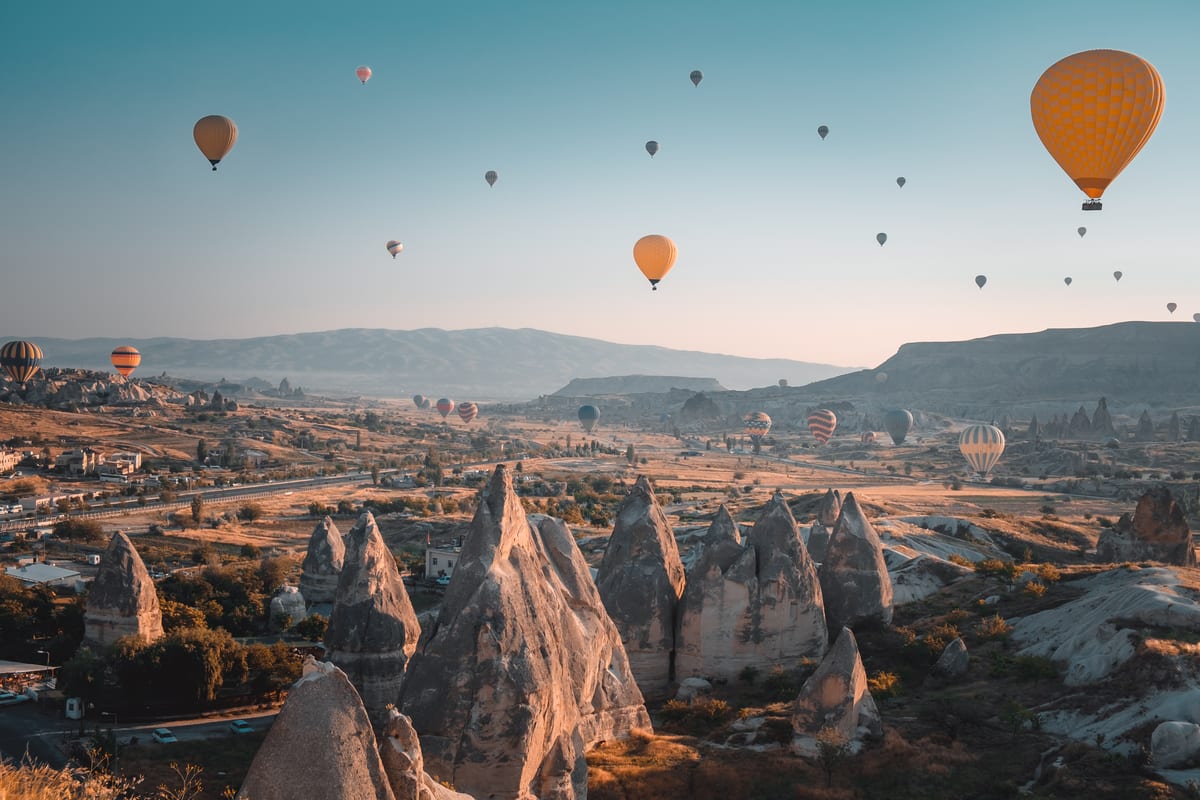
Cappadocia Balloon Photography Camera Settings Guide
Three minutes after sunrise, the light temperature shifts from 3200K to 5000K. Your camera’s auto mode has no idea what to do with that. It overexposes the sky, crushes the shadows on the fairy chimneys, and turns the warm golden light into flat beige. Manual or semi-manual control fixes this—and the settings are simpler than you might expect.
This guide covers camera settings we recommend for each phase of a Cappadocia balloon flight, covering everything from Canon R5 bodies to iPhone 15 Pros. For broader photography advice including gear, composition, and editing, see our complete photography guide.
General Principles for Balloon Photography Settings
Before the specific numbers, understand three things about shooting from a balloon basket:
- The basket is stable but not fixed. You are floating with the wind, so there is almost no vibration—but the basket does rotate slowly and the burner creates brief movement. Keep your shutter speed at 1/125s or faster for sharp results.
- Dynamic range is extreme at sunrise. The sky is bright, the valleys are dark. If you shoot RAW, you can recover 2–3 stops of shadow detail in post. If you shoot JPEG, expose for the sky and accept darker shadows.
- Light changes fast. In the 15 minutes around sunrise, you may need to adjust ISO three or four times. Aperture priority mode (A/Av) with auto ISO capped at 1600 is a reliable fallback if you do not want to go full manual.
DSLR and Mirrorless Settings by Phase
Pre-Dawn: Inflation and Launch
The scene: dark sky, balloon envelopes lit from inside by burner flames, crew silhouettes.
| Setting | Value | Why |
|---|---|---|
| Mode | Manual (M) | Auto will overexpose the dark sky trying to brighten the scene |
| ISO | 1600–3200 | Low light requires high sensitivity |
| Aperture | f/2.8–f/4 | Wide open to gather maximum light |
| Shutter | 1/60s–1/125s | Brace against the basket for 1/60s; 1/125s is safer |
| White balance | 3500K (tungsten/warm) | Preserves the warm burner glow against cool sky |
| Focus | Single-point AF on the balloon envelope | Auto-area AF may hunt in darkness |
Early Ascent: Soft Light (5:20–5:45 AM summer)
The scene: pastel sky, dozens of balloons rising, soft diffused light with no harsh shadows.
| Setting | Value | Why |
|---|---|---|
| Mode | Aperture Priority (A/Av) | Light is changing fast; let the camera adjust shutter speed |
| ISO | 400–800 | Enough light now to lower ISO |
| Aperture | f/5.6–f/8 | Sharp across the frame for multi-balloon shots |
| Shutter | 1/125s+ (auto) | Set minimum shutter to 1/125s in auto ISO settings |
| White balance | 5000K (daylight) | Neutral rendering; the pastel colors come through naturally |
| Metering | Evaluative/Matrix | Even light across the scene; evaluative handles it well |
Golden Hour: Peak Light (5:45–6:15 AM summer)
The scene: warm directional light, long shadows on fairy chimneys, balloons glowing gold on the sun-facing side.
| Setting | Value | Why |
|---|---|---|
| Mode | Aperture Priority (A/Av) or Manual | Light is stable enough for either |
| ISO | 100–400 | Plenty of light; keep ISO low for clean files |
| Aperture | f/8–f/11 | Sweet spot for most lenses; sharp corner-to-corner |
| Shutter | 1/250s–1/500s | Fast enough to freeze any basket movement |
| White balance | 5500–6000K (slightly warm) | Preserves the golden glow; auto WB may neutralize it |
| Exposure compensation | -0.3 to -0.7 EV | Protect the highlights in the bright sky; recover shadows in RAW |
Portrait Mode: People with Balloons Behind
| Setting | Value | Why |
|---|---|---|
| Aperture | f/2.8–f/4 | Blurs the background balloons into soft circles of color |
| Focal length | 50–85mm | Flattering compression for faces; background balloons appear larger |
| Focus | Eye-AF or single-point on nearest eye | Critical for shallow depth of field portraits |
| Metering | Spot on face | Correct exposure on skin, even if sky is bright behind |
Phone Camera Settings
Most phone cameras do well in auto mode during golden hour, but a few manual adjustments improve the results:
iPhone (Pro models with ProRAW)
- Enable Apple ProRAW for maximum editing flexibility. Files are larger (25 MB each), so ensure you have 3–5 GB free.
- Tap and hold on the sky to lock exposure, then drag the sun icon down slightly. This prevents the sky from blowing out white.
- Use the 2x zoom (48MP crop on Pro models) as your default. The 1x is too wide for most balloon-to-balloon shots. The 3x or 5x telephoto works for distant balloons.
- Turn off HDR for sunrise shots. HDR flattens the contrast and removes the dramatic shadow play that makes golden hour special.
- Set Live Photos to off to save storage and avoid accidental movement blur at the start/end of each capture.
Android (Samsung, Pixel, OnePlus)
- Use Pro mode (Samsung) or manual mode (Pixel via third-party app like Open Camera). Set ISO to 100–200 and let shutter speed auto-adjust.
- On Samsung, shoot in RAW format (enable in Pro mode settings). On Pixel, enable RAW in camera settings.
- Set white balance to 5500K manually to lock the warm tone. Auto WB on Android phones tends to overcorrect sunrise warmth.
- Use the 3x zoom on Samsung S23/S24 Ultra for individual balloon isolation. The 10x zoom produces usable results in good light but degrades quickly in pre-dawn conditions.
Quick Settings Cheat Sheet
Save this to your phone or print it before your flight:
| Phase | ISO | f/ | Shutter | WB (K) |
|---|---|---|---|---|
| Pre-dawn | 1600–3200 | 2.8 | 1/60s | 3500 |
| Early ascent | 400–800 | 5.6–8 | 1/125s | 5000 |
| Golden hour | 100–400 | 8–11 | 1/250s | 5500 |
| Portraits | 200–800 | 2.8–4 | 1/250s | 5500 |
| Silhouettes | 100 | 11–16 | 1/500s | 5000 |
Common Settings Mistakes
- Leaving auto white balance on: The camera shifts between warm and cool as you turn in the basket. Every photo looks different. Lock WB to a specific Kelvin value.
- Shooting at f/2.8 for landscapes: Wide open apertures blur the background, which is great for portraits but wastes the sharpness of those distant fairy chimneys. Use f/8 or higher for landscapes.
- Forgetting to lower ISO after sunrise: Pre-dawn settings leave noise in your golden hour shots. Reset ISO to 100–400 once the sun is up.
- Using shutter speeds below 1/125s without bracing: The basket is stable, but you are standing on a slightly flexible floor. Handheld shots below 1/125s risk softness. Lean your elbows on the basket edge for stability.
- Over-trusting autofocus in backlit scenes: When shooting toward the sun, autofocus may lock on the bright sky instead of the balloon. Switch to single-point AF and place the focus point on the balloon envelope.
Frequently Asked Questions
Should I shoot in manual or auto mode?
Aperture Priority with locked white balance and exposure compensation of -0.3 EV is the most reliable approach for most photographers. Full manual gives you more control during the fast-changing pre-dawn phase but requires constant adjustment. Auto mode works in a pinch but tends to overexpose the sky and neutralize the warm tones.
Do I need a polarizing filter?
A polarizer helps reduce haze and deepen the sky, especially during the post-golden-hour phase when light becomes harsher. During golden hour itself, the benefit is modest. If you have one, screw it on before boarding and rotate it to maximum effect while facing 90 degrees from the sun.
What file format should I use?
RAW for maximum editing flexibility, especially for recovering blown highlights and shadow detail in high-contrast sunrise scenes. RAW+JPEG if you want to share photos immediately on WhatsApp or social media without editing. JPEG alone is fine for casual shooters, but you lose the ability to correct white balance and exposure in post.
How do I prevent lens fog in cold mornings?
Keep your camera inside your jacket against your body warmth until boarding. When you take it out, the temperature difference between the warm lens and cold air can cause condensation. Wipe with a microfiber cloth every few minutes for the first 10 minutes. After that, the lens acclimates and the issue stops.
Related Articles
Cappadocia Balloon Ride from Istanbul: Can You Do It as a Day Trip?
Cappadocia balloon ride from Istanbul as a day trip: flight schedules, costs from EUR 150, hour-by-hour plan, and whether one day is enough. Book with Above Cappadocia.
Cappadocia Balloon, ATV & Valley Hike Combo: The Ultimate Adventure Day
Cappadocia balloon, ATV, and valley hike combo: hour-by-hour adventure day plan with sunrise flight from EUR 150, ATV from EUR 35, and free valley hikes.
Cappadocia Balloon October Weather Guide: What to Expect
Cappadocia balloon October weather: 6-13 C at sunrise, calm, stable weather, autumn colors over fairy chimneys. Flights from EUR 150.
Ready to Shoot Cappadocia from the Basket?
Sunrise flights from EUR 150 per person. Bring your camera and put these settings to work from the basket.